Electrical separation remains a design question even where an inverter has sufficient running power for an industrial load. Motors and compressors also impose starting conditions, so a transformer and an output rating describe complementary parts of the proposed supply.
Transformer-equipped products from hybrid inverter manufacturers in China still face the connected motor’s separate starting requirements. The comparison then connects the isolation arrangement to the distribution system and tests the load against separately stated operating limits.
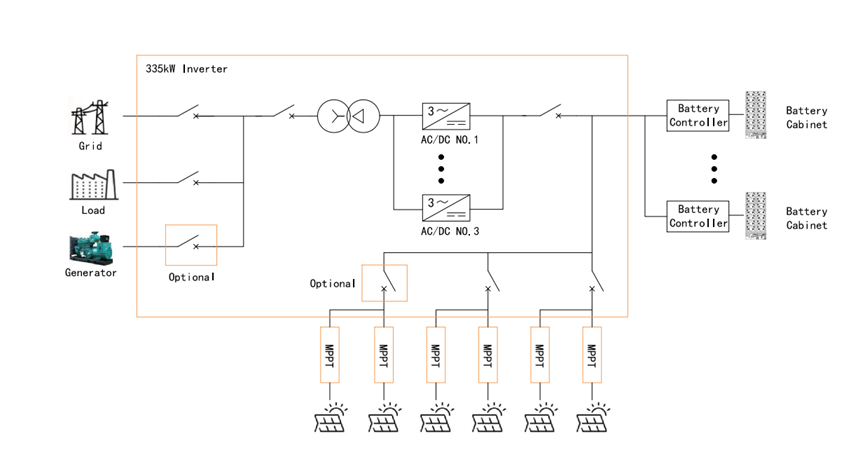
Separation in the Power Circuit
A transformer transfers power between windings through magnetic coupling. In an isolation arrangement, separated windings interrupt a direct conductive connection across that part of the circuit. The electrical boundary therefore needs a defined position on the single-line diagram, with the equipment and circuits on either side identified.
Neutral treatment, protective earthing and fault protection still belong to the installation design. Isolation changes the circuit relationship; the distribution arrangement remains responsible for controlling accessible voltages and responding to faults. The presence of a transformer alone supplies no complete earthing or protection scheme.
Power passing through the transformer also encounters equipment limits. Its applicable rating belongs alongside the converter rating and the connected load, rather than being inferred from the word isolation. Electrical separation gives the component a particular function within that path without establishing unlimited overload capability.
Motor Duty Adds Conditions Beyond Isolation
Continuous power, starting current and the distribution connection place independent constraints on a motor supply. A load may fit the sustained output while its acceleration event still exceeds a permitted operating condition. Those separate acceptance conditions frame a comparison of hybrid inverter manufacturers in China.
At the motor terminals, starting performance depends on the voltage that remains available while acceleration occurs. Circuit impedance and other connected loads influence that voltage. An isolation device cannot substitute for checking the resulting terminal conditions during the proposed start.
The distribution assessment also retains transformer and switchgear ratings. Their role is to establish whether the electrical arrangement accommodates the intended duty, including the current path through connected equipment. A motor label gives no permission to ignore a more restrictive limit elsewhere in that arrangement.
Acceleration also has a mechanical side. The driven machine’s load torque and inertia affect the demand during run-up, while available electrical conditions influence the motor’s ability to develop torque. A starter setting can therefore alter more than a current peak; the proposed arrangement has to allow the machine to reach its intended operating state within the permitted starting duty and respect the constraints of its driven process.
Starting arrangements become load-design variables when a suitable soft starter or sequenced restarting changes the demand at the supply. The revised event can be assessed against the actual equipment limits. The transformer performs its isolation role within that newly defined operating case.
Two Transformer-Based Industrial Configurations
The built-in transformer places the GWTime GWP335TS-400-A within the isolation-based category, alongside its 335 kW rated output and 484 A rated AC current. Its output arrangement is 230/400 V with neutral and protective earth at 50/60 Hz. The DC operating range is 680-950 V, with maximum DC current of 609 A.
The larger GWP500TS-400-A incorporates an isolation transformer for heavy motor and compressor loads and provides 500 kW rated output. Its maximum AC output current is 794 A, and it supplies direct 400 V AC output. A standard STS handles grid-connected and island transfer, with on/off-grid switching specified below 20 ms.
Both models have IP54 enclosure protection, but their physical installation requirements differ. The 335 kW cabinet measures 1250 by 1050 by 2050 mm and weighs 1800 kg. The 500 kW cabinet measures 1300 by 1050 by 2050 mm and weighs 2200 kg, placing a different equipment mass and footprint into the site layout.
These examples locate isolation beside identified electrical and physical parameters. Neither cabinet inherits a numerical motor-start overload allowance from a smaller product merely because the equipment serves industrial applications. Any claimed temporary duty remains attached to the model and conditions for which it is specified.
Relating Product Evidence to the Installation
Manufacturing information establishes a different part of the equipment record from a motor acceptance test. Comparing hybrid inverter manufacturers in China on that basis separates factory process coverage from evidence for a particular starting duty. A named test condition remains necessary wherever a performance figure depends on a specific load or operating state.
GWTime uses load profiles, grid behaviour and project economics to establish the project design basis, linking industrial supply requirements to the site’s operating problem. The discussion can then identify which connected duties require isolation and which starting conditions need separate examination alongside the proposed transformer arrangement.
Quality control at GWTime covers incoming raw materials through final product dispatch. That coverage identifies the stages included in manufacturing checks. The separate installation assessment still needs the proposed electrical diagram, motor details and applicable equipment ratings to establish the relationship between the delivered hardware and its intended service.
Electrical isolation answers a circuit-relationship question within a wider industrial supply decision. The motor event, continuous duty, distribution arrangement and installation conditions retain their own acceptance roles. An appropriate configuration gives each requirement a corresponding function and rating, with the transformer located within the complete supply arrangement that the load will actually encounter.